
David chats about the benefits we get from the act of giving.
Being selfish is often defined as acting for your own benefit. Being selfless, on the other hand, means acting for the benefit of others – what we commonly call altruism. But what if the two are not as separate as we think? When we perform an act of kindness, the body releases oxytocin, also referred to as the ‘love hormone.’ Oxytocin plays a vital role in social bonding, reducing stress, building trust and supporting overall wellbeing. It has a significant impact on both our physical and mental health.
So, the question becomes: when we give selflessly, are we truly being selfless? Or, are we subconsciously seeking the feel-good effect that oxytocin provides?
Human beings have survived for thousands of years, not because we were the strongest individually, but because we functioned more effectively in groups. Over many years, evolution has wired us for connection. In early human history, survival depended on cooperation. If one person watched for predators while another slept, both benefited. Oxytocin acts as a biological reward system, encouraging behaviours that strengthen social bonds. It’s the body’s way of reinforcing connection. In that sense, feeling good after helping someone is not accidental; it’s instead an evolutionary design.
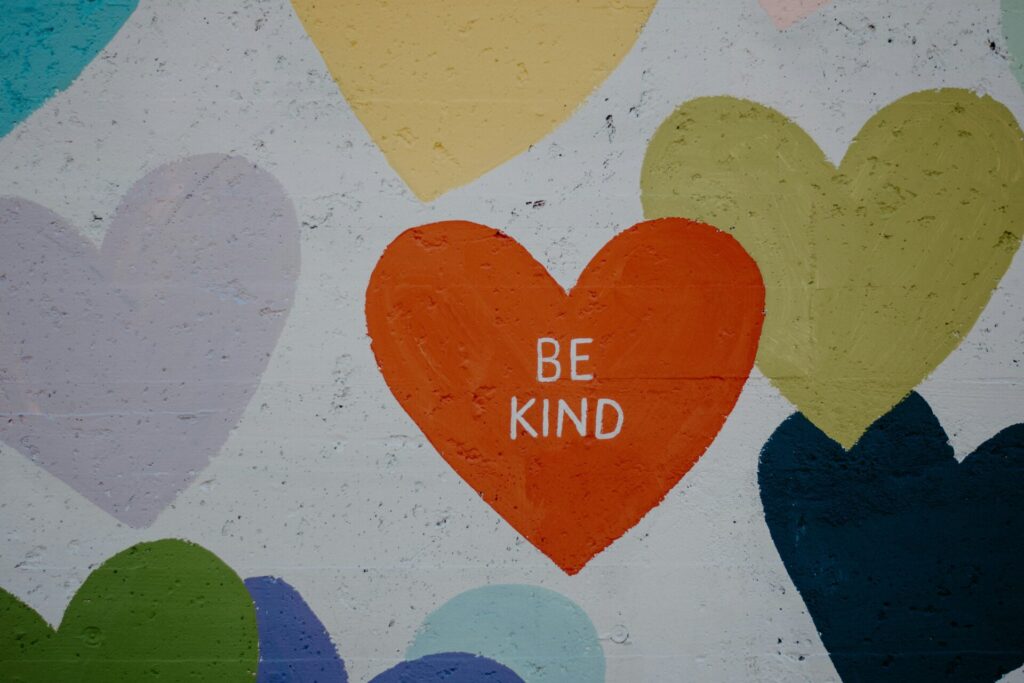
The act of giving can also influence confidence. While it may not directly create confidence, it enhances how we feel about ourselves. When we feel our best, we perform our best. After helping someone, there is often a noticeable shift, such as a lighter mood, a sense of purpose, or that extra spring in your step. That internal boost can show externally, making you appear more confident simply because you’ve just made someone’s day better. Here lies the paradox. If someone experiences kindness and it improves their day, perhaps even inspiring them to pass it forward, that is clearly positive. But the giver also benefits emotionally and chemically. The song ‘Cruel to Be Kind’ by Nick Lowe reflects the complexity of kindness. Sometimes kindness is firm and honest rather than soft, yet it still comes from care.
The key difference lies in intention. If giving is done with the expectation of praise, recognition or repayment, it becomes transactional and the purpose of the giving is no longer valid. True giving doesn’t cling to outcome. It’s offered freely, without attachment to what happens next. Kindness doesn’t need expectation. Nelson Mandela said, “As I walked out the door toward the gate that would lead to my freedom, I knew if I did not leave my bitterness and hatred behind, I would still be in prison.”
I once knew someone whose father devoted much of his free time to helping others. Outside of his full-time job as a teacher, he supported the local church and delivered donated furniture to families in need. He rented a warehouse to store items that people no longer required. When someone moved into the community without essential furniture, he organised deliveries to ensure they had what they needed. He received no financial reward, yet the sense of purpose, motivation and confidence it gave him was undeniable. The emotional reward sustained him. He gave because it aligned with who he was.
Some people resist receiving help due to pride, independence or personal values. In those situations, generosity may require creativity. Support can be offered in ways that preserve dignity both quietly and indirectly, without drawing attention. Sometimes kindness is most powerful when it’s subtle. Altruism may release oxytocin. It may improve wellbeing and boost confidence. But, when the intention is genuinely to uplift another person, the fact that the giver also feels good doesn’t make the act selfish.
It simply means kindness is powerful. The more we give, the more human we become.
So, in what ways could you give to someone in need?