
Justine chats about emotions and how we can learn to ‘Surf the Urge’.
Should we express our emotions in the workplace? There are a lot of myths about expressing emotion at work, and how this can impact you. Some of these commonly heard myths are:
- It’s not professional
- Emotions belong at home
- If you express your emotion at work, you might be told you’re too aggressive, too emotional, or that you’ve got no self-control
But what if emotions give us useful information? What if being able to name them makes us more trustworthy leaders? Anger may tell us that we’re feeling powerless to make a change. Fear may tell us we need to take action. Sadness may tell us we’re losing something that’s important to us. There’s a difference between acknowledging the emotions you feel and the way you express them. Making that distinction is important to help you decide what to do with the information your emotion is giving you.
It can often be tricky to make the distinction between our emotions in the moment, meaning we can express our emotions ‘wrong’ at work (and even at home). I imagine most of us have said something that came out not quite as we meant it, or that we regretted later.
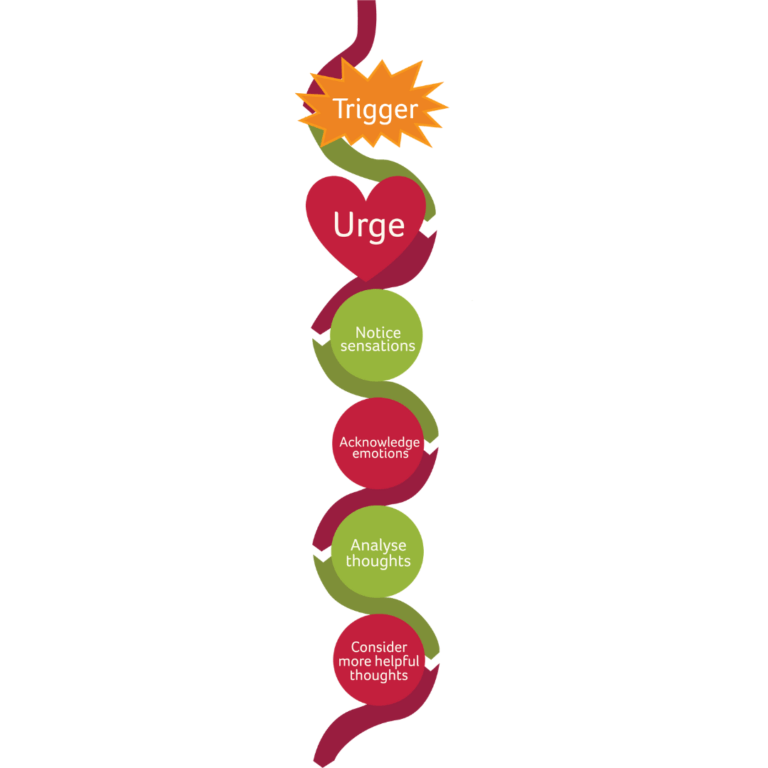
At Rambutan, we created a five-step model called ‘Surf the Urge’ to help us to understand our emotions. It’s a great model to use when we’re feeling upset or triggered at work and want to be able to handle ourselves professionally. Here’s an example putting the five steps into practice:
Let’s say you’ve been interrupted multiple times in a meeting by the same person. They never let you finish your sentence…
1. Notice your urges
For example, if the person constantly interrupting you makes you feel angry, you might have an urge to raise your voice at them.
2. Notice sensations
Intense emotions such as anger quickly bring changes to our physical state. Get curious about what’s happening in your body. Changes might include your hands getting hot, a rush of blood to your belly, feeling like you want to cry, or even feeling a white heat in your shoulders.
3. Label the emotions
Noticing the sensations in your body helps you make the connection to the emotion you’re feeling, ‘Oh, this is what happens when I feel angry!’
Dr. Marc Brackett, Founding Director of Yale Center for Emotional Intelligence, and author of, ‘Permission to Feel’ cites evidence that shows if we can name our emotions with clarity, the intensity of the emotion dissipates quickly.
Brackett shares that naming emotions with more nuance has significant benefits such as lowering blood pressure, reducing stress, fewer visits to the doctor, less absenteeism at work and a longer-term improvement in mood.
4. Analyse your thoughts
Notice what thoughts you’ve begun to have about the person who interrupted you. Often when we’re having an intense emotion such as anger, it’s natural for us to judge others as a way of protecting ourselves. You might find yourself thinking, ‘They’re such an idiot’, ‘They have no respect for me’, or ‘My contribution is not valued.’
Try pausing and asking yourself whether these thoughts are helping you or hindering you.
Taking a moment to breathe can help you slow down and analyse your thoughts. You could do this by slowing your breathing, counting to ten, or subtly touching each one of your fingers with your thumb, a technique that helps you stay present and grounded.
I like to have a couple of holding statements in my toolkit so that I can respond calmly in the moment, such as, ‘Do you mind if I finish?’ or, when there’s a break in the conversation, ‘Continuing my thought from earlier.’
5. Choose different thoughts
In his book, ‘Man’s Search for Meaning’, Viktor Frankl said that in the moment between a stimulus and response, there is a gap, and that gap is our moment of choice. He reminds us that we always have the power to choose different thoughts. For example, you could imagine what that person is going through, even if they don’t share it with you. Maybe the person just had a difficult conversation with their boss, and they’re feeling under pressure to prove themselves; perhaps they’re so enthusiastic about their ideas that they forget to listen to others attentively.
When we have more awareness of our emotions and can express them, we’re more trustworthy. Think of the last time you were with a leader who was reacting with intense emotions but had no clue what they were feeling; there’s a lack of stability. Now, think of a leader who can share how they feel with honesty and self-awareness; there’s safety.
Practicing the ‘Surf the Urge’ steps allows you to be more grounded and receptive, and opens the door for you to talk with your colleague respectfully about them interrupting and how it made you feel. You get to respond with more wisdom.
It’s normal to feel intense emotions regularly. Next time, ignore the myths, and try surfing the urge. When could you put ‘Surf the Urge’ into practice?