
Hannah chats about stress and how it can have a positive impact.
Stress creates changes in our bodies to prepare for and respond to challenges. In caveman times, our body would need to be in a state of readiness to go hunting, but in modern life, we can live in a high state of awareness and day-to-day stress. Even down to things like having access to email on our phones makes us feel we have to be constantly on duty, which in turn keeps stress levels higher.
It’s really interesting how different people respond to stress. Some see it as a very negative thing, whilst others see it as a positive that our body is helping to prepare us to face whatever life throws our way. What’s really interesting, as Kelly McGonigal tells us, is that people who believe stress can be positive for them, will actually live longer than those who see it as a bad thing and even those who experience very little stress at all. This all links to perspective and the tangible results of having and utilising a growth mindset.
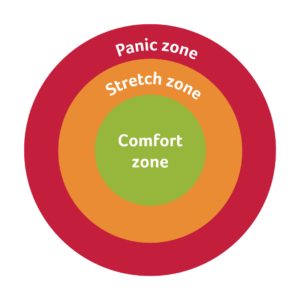
Carol Dweck’s talk on mindset shows that if we see learning as a positive challenge, we can enhance our performance. When talking about mindset, I like to think of the image of a circle, with our comfort zone in the middle, then our stretch zone and our panic zone surrounding it. The more we’re willing to creep into activities in our stretch zone, the more we’ll expand our comfort zone. I think this links to our perception of stress and our approach to dealing with it, for example, practising resilience exercises to improve the way we handle stress.
We’re not all born with great natural resilience to stress, but it’s something that can be developed. For this, we look to Kelly’s sister, Jane McGonigal, who delivered a brilliant TED Talk, ‘The game that can give you 10 extra years of life’. She talks about tangible things that we can do to build up our resilience and our wellbeing, which can in turn increase our lifespan. It’s a great watch to find some suggestions about what we can do to improve our own situations.
Everyone’s got their own ways of managing stress; I like to walk my dog on the beach and have some time away from things that can send my blood pressure soaring. When I’m facing something that’s new or challenging, I like to think about ‘what’s in it for me’ – what am I going to learn that will expand my comfort zone? Preparation prevents poor performance and in a work situation, having our ducks in a row helps take the edge off and reduce stress, so we can look in the mirror and confidently say, “you’ve got this.”
Making sure we recognise our bodies’ responses and being aware of our emotions is so important to help ground us in moments of stress. We can do this by naming our feelings. In a situation that’s starting to make me feel overstretched, I find it important to ask myself, “Ok, I’m feeling uncomfortable right now, but why is that?”
If our bodies felt no stress response at all, we’d be less able to face challenges and try new things. An amazing book I recommend reading is, ‘The Four Pillar Plan’ by Rangan Chatterjee. He talks about the different pillars that help maintain our wellbeing and are therefore helpful in countering stress, and how bodies are designed to deal with moments of it rather than a prolonged state of stress.
I believe it can be really useful to understand where our stress comes from and what it does for us, both positively and negatively. What mindset could you choose, to see stress as a positive?